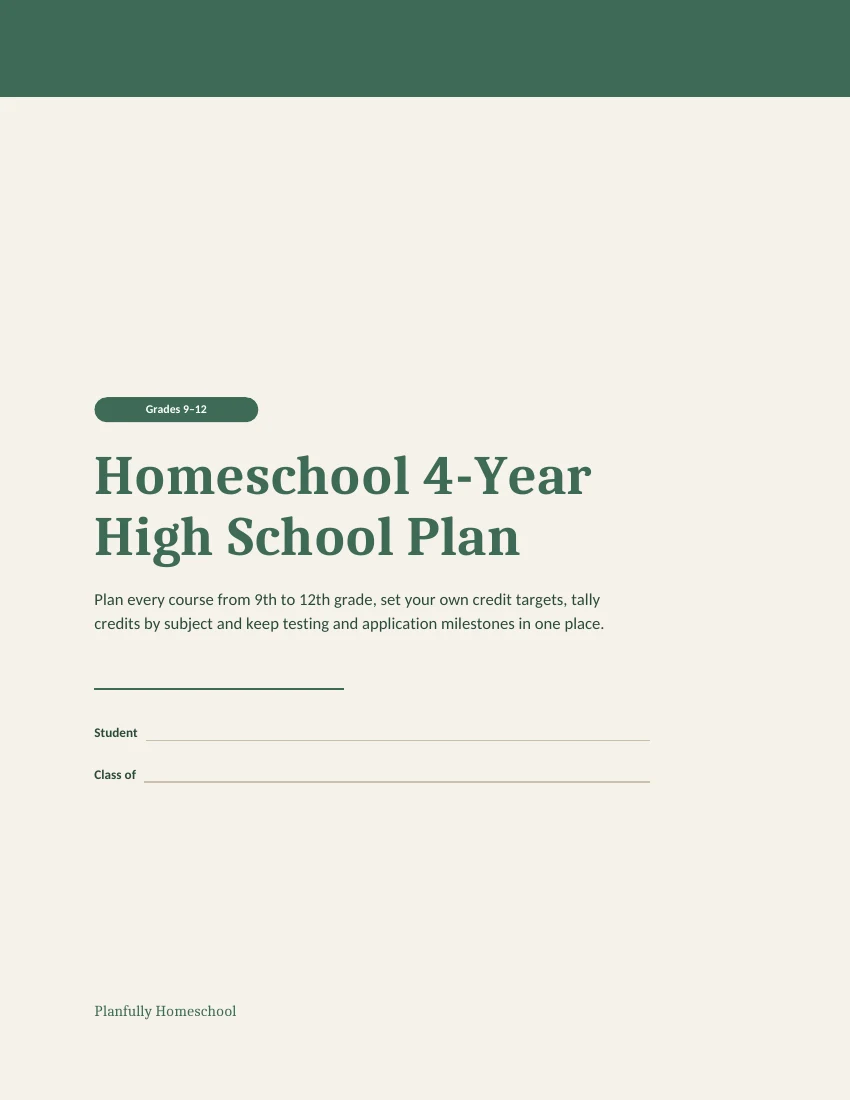
This homeschool 4-year high school plan template maps every course from 9th to 12th grade and adds up the credits for you. List each course once, and the spreadsheet totals credits by subject area against targets you set, flags any subject that’s short, and lays out all four years on one printable page. A 12-page printable version is included for families who plan on paper.
A template you complete. Check your state’s rules and each college’s or program’s requirements.
What’s inside
- Settings: student name, graduation year and your own credit target for each subject area. You can rename the subject areas.
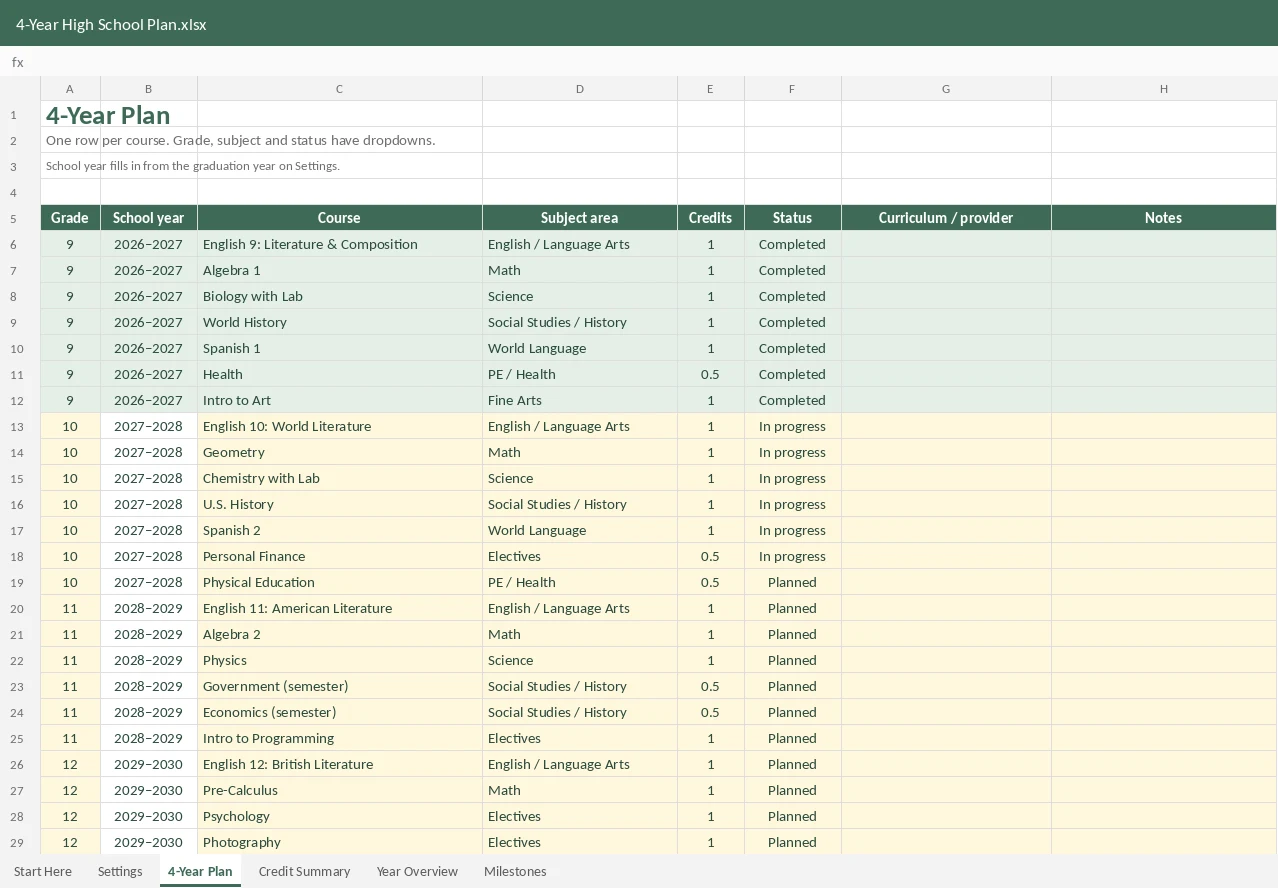
- 4-Year Plan: up to 80 courses. The school year fills in from the graduation year, and completed courses turn green.
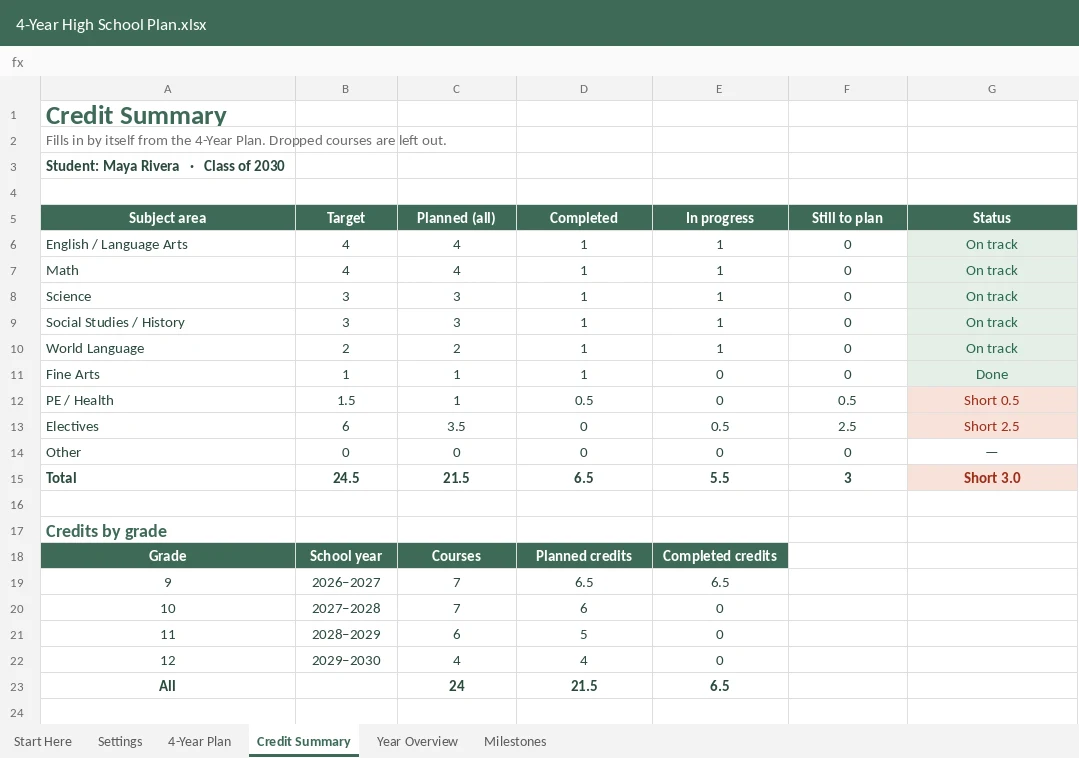
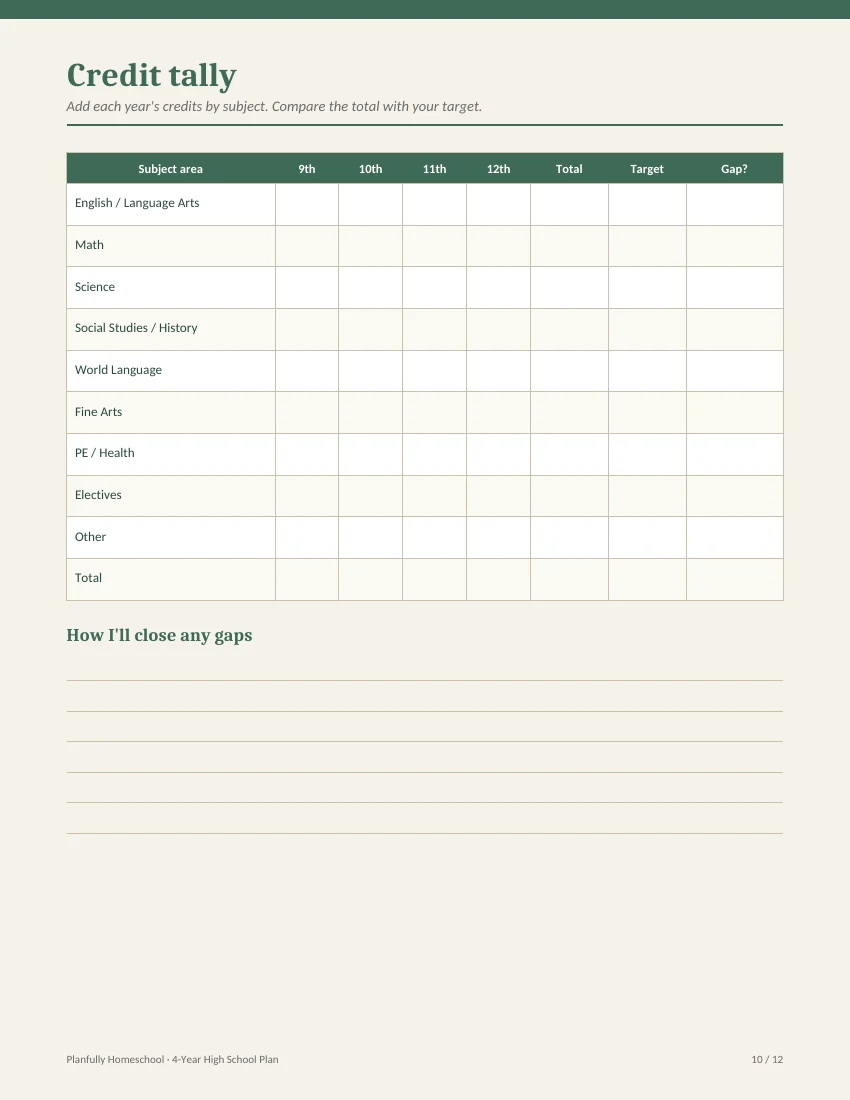
- Credit Summary: target, planned, completed and in-progress credits per subject, how much is still to plan, and the credits for each grade.
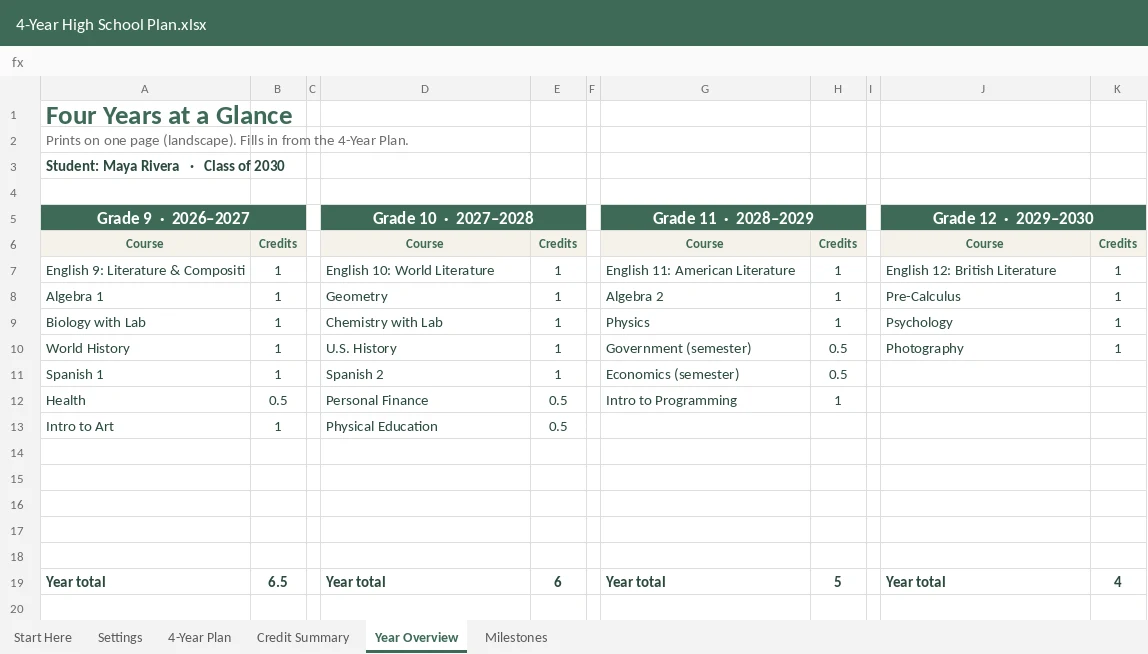
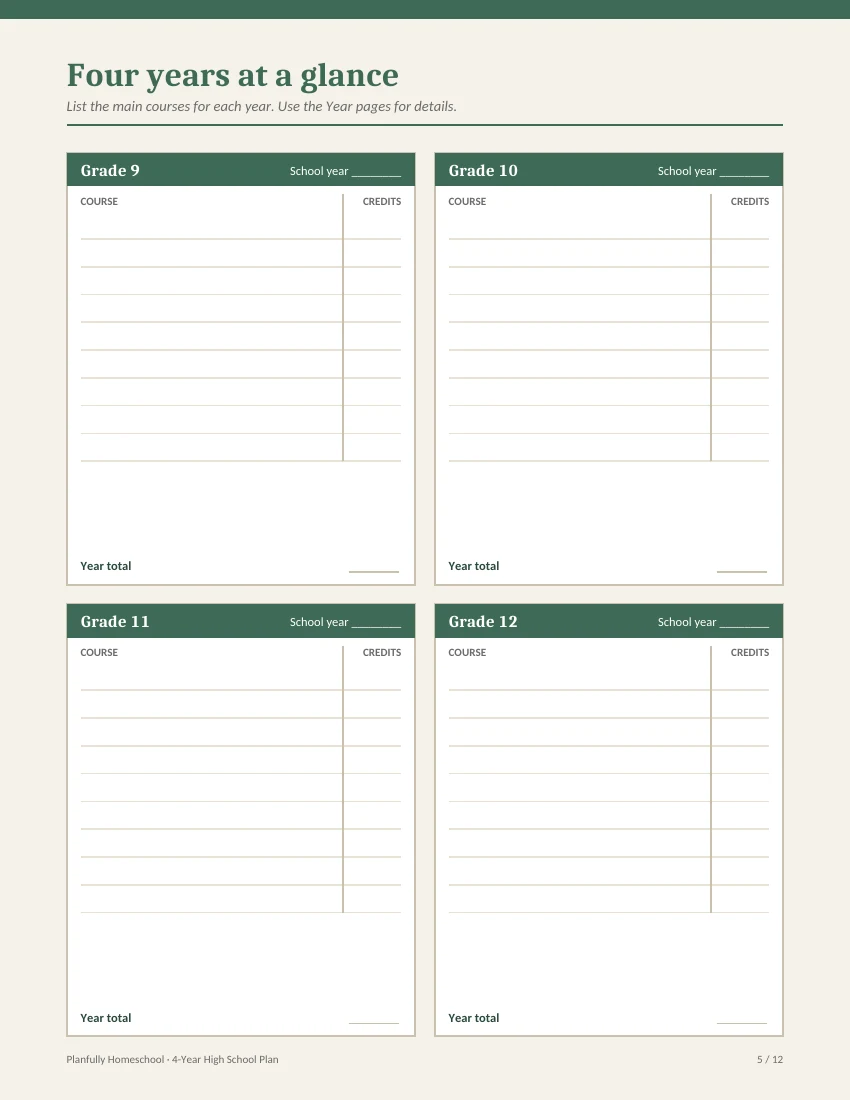
- Year Overview: all four years side by side with year totals. Prints on one landscape page.
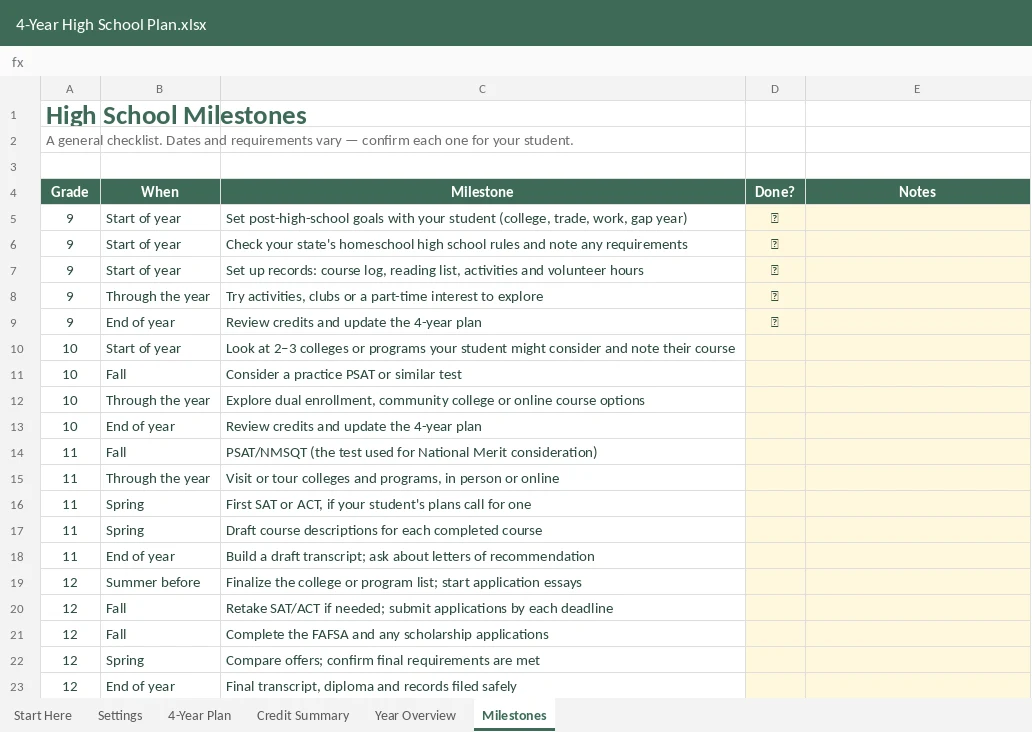
- Milestones: a checklist of testing, research and application steps for each grade, plus blank rows for your own.
- Printable PDF (12 pages): goals and paths, credit targets, four years at a glance, a page for each grade, a credit tally, the milestones checklist and notes.
How to make a 4-year high school plan
- Start with the end in mind. Talk with your student about what might come after graduation: college, trade school, work, the military or a gap year. You don’t need a final answer; two or three possibilities are enough to plan around.
- Set your credit targets. Look up your state’s homeschool high school rules, then the requirements of two or three colleges or programs your student might consider. Enter a target for each subject area on Settings.
- Map the core subjects first. Place English, math, science and social studies across the four years. Then add world language, fine arts and PE/health, and fill the remaining space with electives.
- Check the gaps. Open the Credit Summary. Anything marked “Short” still needs a course, so move one, add a semester class or plan a summer course.
- Revisit every year. Mark courses Completed as they finish and adjust the plan as your student’s goals become clearer.
Example plans
The example file shows a full college-bound plan for a student in the class of 2030. Here’s how the same template fits other paths:
- College-bound: four years of English and math, three or more lab sciences, and two years of one world language are common in plans like this. Check each college’s own list.
- Career or trade: keep the core subjects and use electives for shop, technical or apprenticeship-related courses. Many families add a personal finance course.
- Dual enrollment: list community college courses with the high school credit you assign them. Write the college name in the Curriculum / provider column so it’s easy to find later.
How high school credits usually work
In most homeschool records, a full-year course counts as 1 credit and a semester course as 0.5. Many families base a credit on roughly 120–180 hours of work, or on finishing a full high school textbook or course. Your state may define it differently, so check before you set targets. Spreading credits evenly, about 6 to 7 a year, keeps any one year from becoming overloaded.
Who it’s for
- Parents planning homeschool high school who want to see all four years at once.
- Families who want to catch a missing science or language credit in 10th grade, not 12th.
- Teens who plan their own courses with a parent.
Who it’s not for
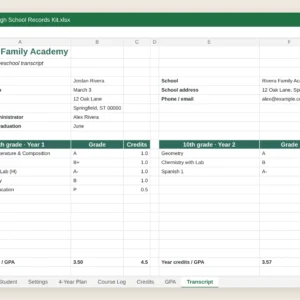
- Making the transcript itself. For that, use the Homeschool Transcript Template & High School Records Kit, which includes a simpler 4-year plan, a course log, GPA and a transcript that fills itself in.
- Day-to-day grades. The Homeschool Gradebook works out each course grade.
Formats & compatibility
- Spreadsheet (.xlsx), blank and with a worked example, for Excel 365, Excel 2019 and Google Sheets.
- Printable PDF, 12 pages, US Letter.
Questions
How many credits does a homeschool high schooler need?
There’s no single number. It depends on your state’s rules and on what colleges or programs your student is aiming for. Many plans end up somewhere around 22–26 credits. Set your own targets, and the Credit Summary shows how close you are.
Does this plan meet my state’s graduation requirements?
It doesn’t claim to meet any state’s or college’s requirements. It’s a template you fill in with targets you choose after checking those requirements yourself.
Can I plan courses taken in 8th grade or over the summer?
Yes. Add them under the grade you want them counted in and write “8th grade” or “Summer” in Notes.
How is this different from the 4-year plan in the Transcript Kit?
The Transcript Kit’s plan is a simple list for planning credits next to the transcript. This product is built for planning: targets with gap flags, credits by grade, a one-page overview, a milestones checklist and a full printable planner.
Can I use it for more than one student?
Make a copy of the file for each student. You can use it for your own family, year after year.
Does it work in Google Sheets?
Yes. Upload the .xlsx to Google Drive and open it with Google Sheets. The dropdowns, totals and gap flags all keep working.
Related
Ready to record finished courses? The Transcript Template & High School Records Kit turns them into a transcript with GPA. Planning the books and curriculum for each course? Use the Homeschool Curriculum Planner. Planning a teen’s own weekly work? Try the Homeschool Student Planner.
Related guides: Homeschool high school credits · How to calculate homeschool GPA